
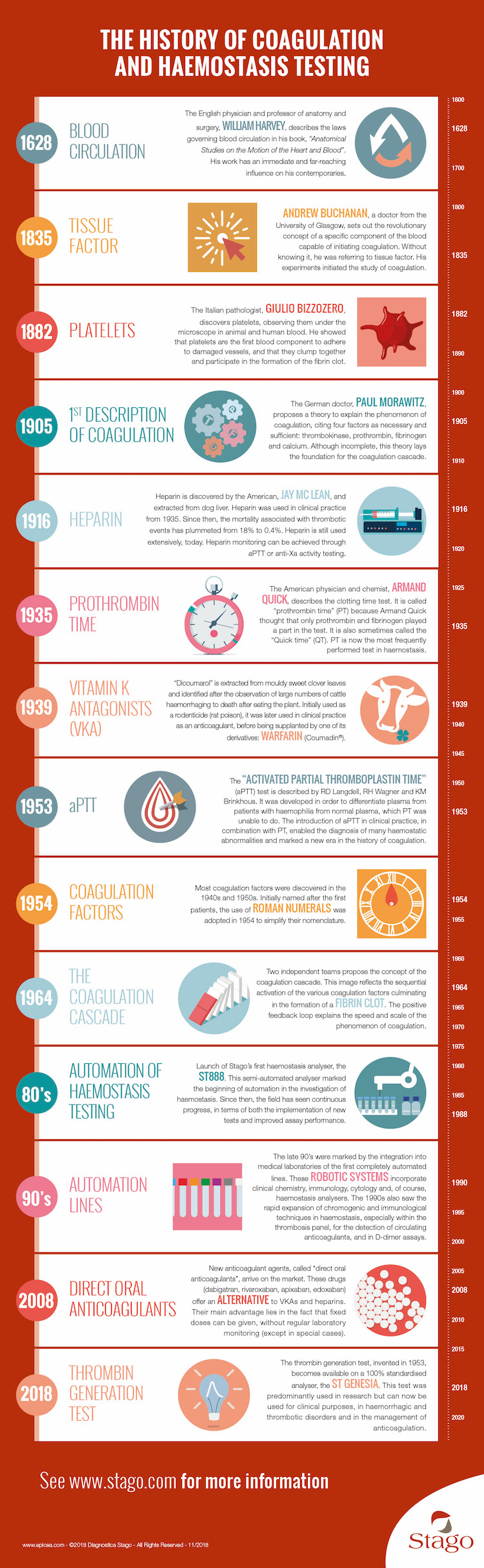
1628

Blood circulation
The English physician and professor of anatomy and sergery, William Harvey, describes the laws governing blood circulation in his book, "Anatomical Studies on the Motion of the Heart and Blood". His work has an immediate and far-reaching influence on his contemporaries.
1835

Tissue factor
Andrew Buchanan, a doctor from the University of Glasgow, sets out the revolutionary concept of a specific component of the blood capable of initiating coagulation. Without knowing it, he was referring to tissue factor. His experiments initiated the study of coagulation.
1882

Platelets
The Italian pathologist, Giulio Bizzozero, discovers platelets, observing them under the microscope in animal and human blood. He showed that platelets are the first blood component to adhere to damaged vessels, and that they clump together and participate in the formation of the fibrin clot.
1905

1st description of coagulation
The German doctor, Paul Morawitz, proposes a theory to explain the phenomenon of coagulation, citing four factors as necessary and sufficient: thrombokinase, prothrombin, fibrinogen and calcium. Although incomplete, this theory lays the foundation for the coagulation cascade.
1916

Heparin
Heparin is discovered by the American, Jay Mc Lean, and extracted from dog liver. Heparin was used in clinical practice from 1935. Since then, the mortality associated with thrombotic events has plummeted from 18% to 0.4%. Heparin is still used extensively, today. Heparin monitoring can be achieved through aPTT or anti-Xa activity testing.
1935

Prothrombin time
The American physician and chemist, Armand Quick, describes the clotting time test. It is called “prothrombin time” (PT) because Armand Quick thought that only prothrombin and fibrinogen played a part in the test. It is also sometimes called the “Quick time” (QT). PT is now the most frequently performed test in haemostasis.
1939

Vitamin k antagonists (VKA)
"Dicoumarol" is extracted from mouldy sweet clover leaves and identified after the observation of large numbers of cattle haemorrhaging to death after eating the plant. Initially used as a rodenticide (rat poison), it was later used in clinical practice as an anticoagulant, before being supplanted by one of its derivatives: warfarine (Coumadin®).
1953

aptt
The "ACTIVATED PARTIAL THROMBOPLASTIN TIME" (aPTT) test is described by RD Langdell, RH Wagner and KM Brinkhous. It was developed in order to differentiate plasma from patients with haemophilia from normal plasma, which PT was unable to do. The introduction of aPTT in clinical practice, in combination with PT, enabled the diagnosis of many haemostatic abnormalities and marked a new era in the history of coagulation.
1954

Coagulation
factors
Most coagulation factors were discovered in the 1940s and 1950s. Initially named after the first patients, the use of ROMAN NUMERALS was adopted in 1954 to simplify their nomenclature.
1964

The coagulation cascade
Two independent teams propose the concept of the coagulation cascade. This image reflects the sequential activation of the various coagulation factors culminating in the formation of a FIBRIN CLOT. The positive feedback loop explains the speed and scale of the phenomenon of coagulation.
1980's

Automation of haemostasis testing
Launch of Stago’s first haemostasis analyser, the ST888. This semi-automated analyser marked the beginning of automation in the investigation of haemostasis. Since then, the field has seen continuous progress, in terms of both the implementation of new tests and improved assay performance.
1990's

Automation lines
The late 90’s were marked by the integration into medical laboratories of the first completely automated lines. These ROBOTIC SYSTEMS incorporate clinical chemistry, immunology, cytology and, of course, haemostasis analysers. The 1990s also saw the rapid expansion of chromogenic and immunological techniques in haemostasis, especially within the thrombosis panel, for the detection of circulating anticoagulants, and in D-dimer assays.
2008

Direct oral anticoagulants
New anticoagulant agents, called “direct oral anticoagulants”, arrive on the market. These drugs (dabigatran, rivaroxaban, apixaban, edoxaban) offer an alternative to VKAs and heparins. Their main advantage lies in the fact that fixed doses can be given, without regular laboratory monitoring (except in special cases).
2018

Thrombin generation test
The thrombin generation test, invented in 1953, becomes available on a 100% standardised analyser, the st genesia. This test was predominantly used in research but can now be used for clinical purposes, in haemorrhagic and thrombotic disorders and in the management of anticoagulation.